
FindUrMeds Update #2: At What Level Do You Solve a Problem?
balancing D2C ads, provider partnerships, redesigning a landing page, and wrestling with prioritization and distribution models for small AI products

When I last shared an update on FindUrMeds, I had just wrapped up my first round of partnerships and initial experiments with Meta ads. Since then, the journey has been equal parts frustrating and clarifying. Here’s what I’ve been working through:
The Meta Ads Problem
Running Meta ads was far harder than I expected. Some learnings:
Many of my ads were flagged or removed because on the surface “FindUrMeds” sounds like a service selling controlled substances, even though what we actually do is use AI to call pharmacies and help patients locate their prescribed medications in shortage. This is a new service that isn’t conceptually understood.
Even when I got ads approved, my bounce rate was ~90%, compared to, according to SimilarWeb. That meant people were clicking but not sticking around. There are 2 potential causes:
bad traffic — Meta is surfacing bad traffic to my landing page
a bad landing page: my landing page didn’t communicate enough trust or clarity for a health product. For something as sensitive as ADHD meds, design and copy matter.
Meta is a selfish algorithm. While many businesses have been built by using D2C ads, Meta’s purpose is to take your money. In my case, Meta was focusing on clicks to my landing page. But I later realized that what I should have done is focus conversion events on clicks to my CTA, not just visits to my landing page.
The Landing Page Rebuild
I paused partnerships to focus on fixing the site. What I learned:
This was my original page:
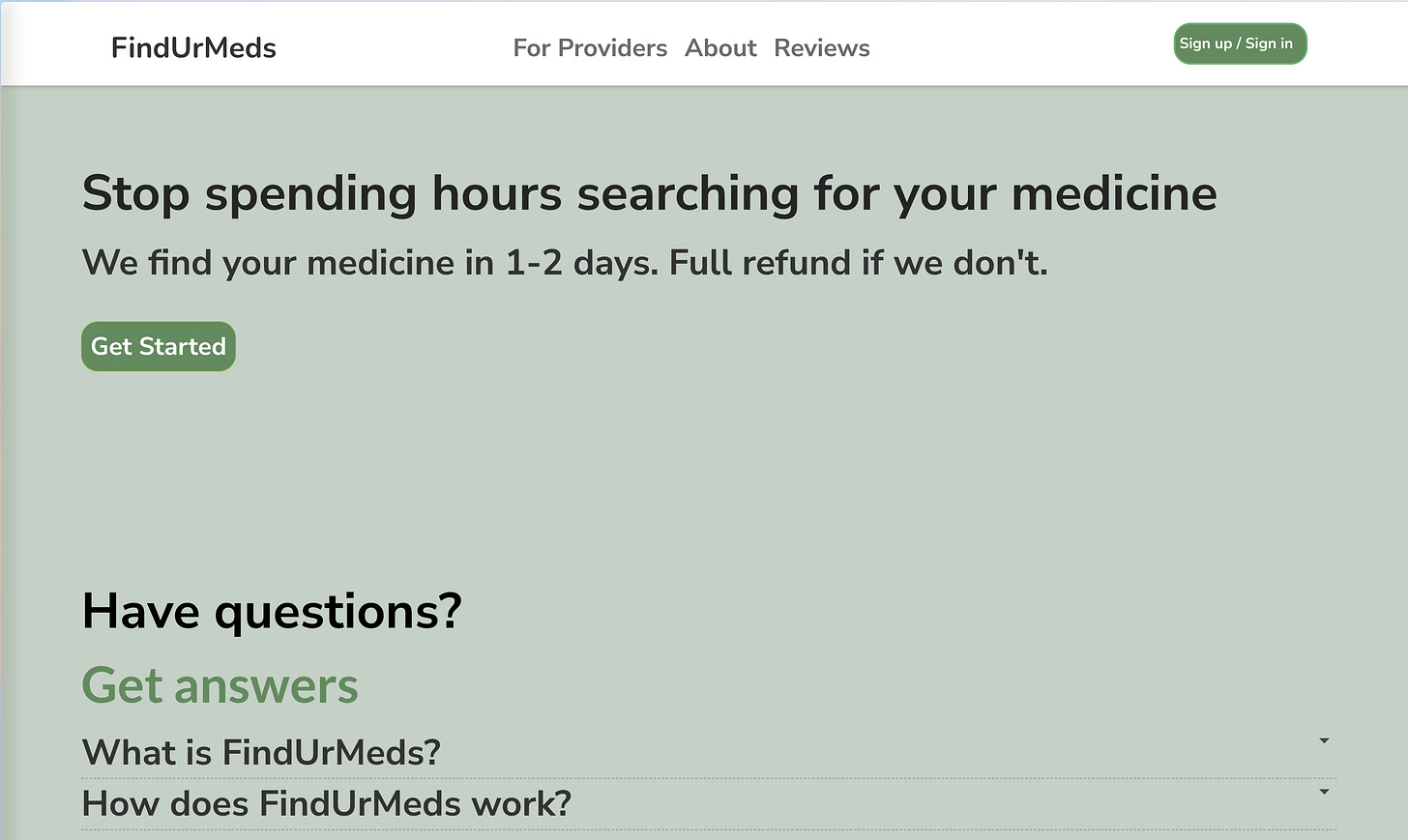
Core problems I had:
Bad CTA that didn’t relate to emotional needs of users
The page didn’t clearly explain how the product worked
Not enough color contrast, the bareness —> lack of trust
Not helping solve core user-problem:
users need medicine; they don’t need to onboard or signup to a website.
My headline didn’t address their emotional pain
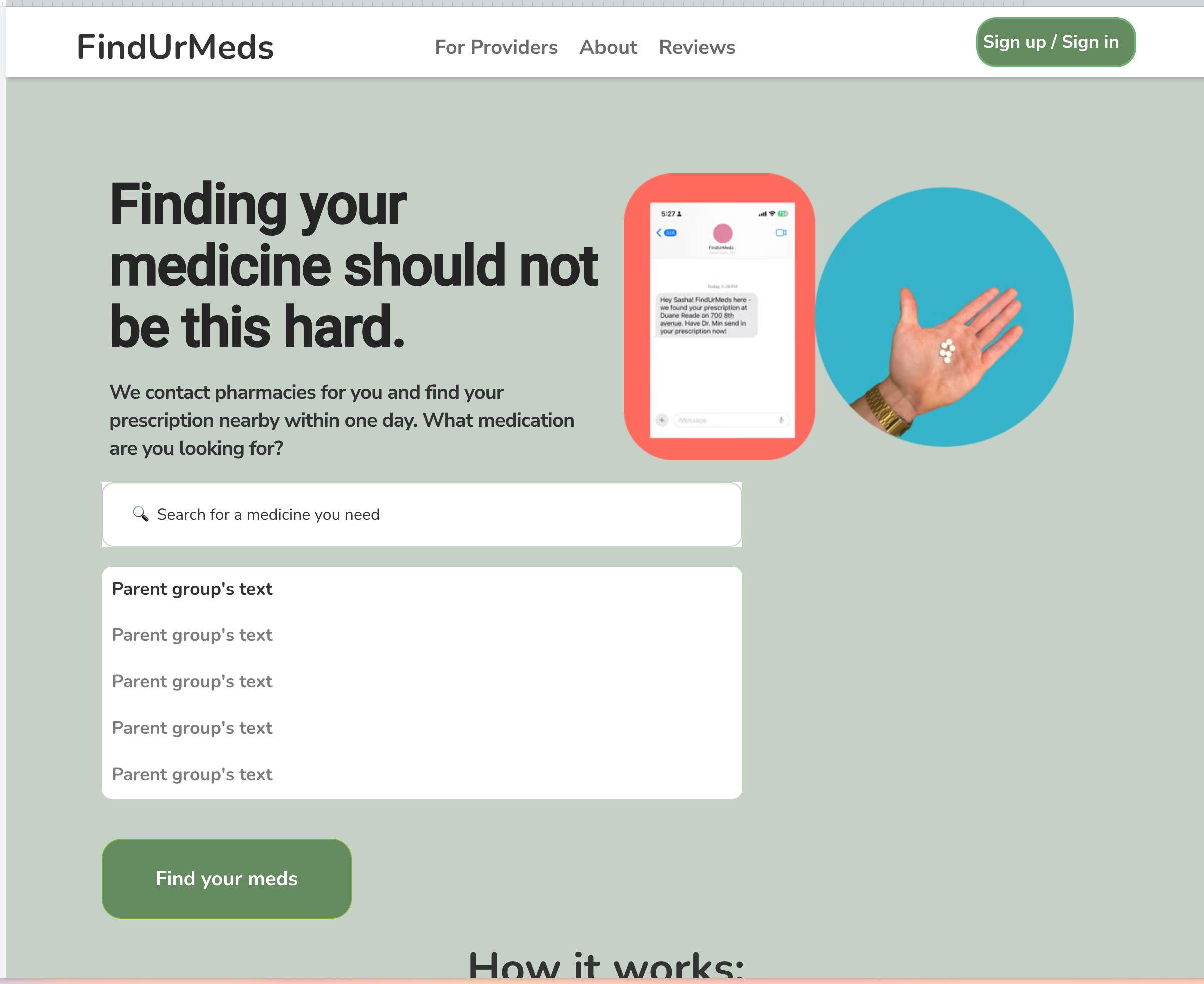
After re-design (so-far)
What I did to improve the homepage:
I moved search to the homepage. Users need medicine; they don’t need to onboard. Being able to search for medicine helps them solve the problem
Changed my headline to be emotion driven
Added soothing visuals to make the page feel less bare-bones
Rewrote my search feature entirely:
I had previously written a hacked together Bubble + HTML version. I moved to Algolia for fast, reliable search across 6,000+ medicines.
This was far more painful to integrate than I expected—Bubble makes API plumbing tricky—but the end result is a search that actually feels real.
Finally:
(WIP) figuring out how to add trust / testimonials as a new product. This is a chicken and the egg problem: to get usage, as a health care product, you need some form of social-trust and testimonials, which you usually lack when starting out.
Entrepreneurship Questions I’m wrestling with:
At what level do I solve a problem?
Example: my bounce rate was at 90%. I suspected this was both because of a) bad-traffic, and b) bad landing page. I knew that moving medicine search — a key user action — to the front of the page, might fix this. However, my search was janky and required a substantial amount of fixing. Did I a) put in a search bar that was not working, but still allowed me to test whether users would stop bouncing if they could take an action to solve their problem? I opted for the full fix.
How to prioritize between marketing channels?
Still looking to figure out D2C:
Easier feedback loop, both in measuring content + competitive research + generating content
Partnerships:
Allows you to scale with groups of providers
Requires more introductions, follow-ups, and selling to a conservative stakeholder
What is the right type of AI business to build as a solopreneur or similar ?
My hunch is to look for essential workflows in antiquated industries like:
pharmacies: brick and mortars haven’t changed in decades
older SMBs: service businesses, restaurants etc
Try to ensure the workflows:
Aren’t of interest to existing Sass companies to build, because:
regulatory (‘legitimate’ companies like GoodRx are squeamish around finding medicine)
not high enough leverage given much higher costs
Have an advantage in distribution: (some possible ways here)
enterprise sales means easier sales cycle, less of a need for cut-throat marketing
can tap into existing distribution network — examples here I’ve seen friends do are making software for influencers (they each have many customers), lawyers (each lawyer has many clients etc)
Lessons on Time & Prioritization
I consistently underestimate how long things take. Setting up Meta ads wasn’t “mock up an ad → run it.” It meant wrestling with:
Custom audiences
Repeated takedowns
Confusing Meta dashboards
Similarly, rebuilding the search bar was “just use Algolia” in theory, but days of debugging in practice. I spent 6+ hours using a different search plugin on Bubble that I ended up abandoning because it was buggy
The broader lesson: scope projects with a time buffer and be honest about hidden complexity.
Secondly, be mindful of inflection points, ie the 80/20 rule. For me, an inflection point is getting Meta Ads to convert successfully — not to merely dump people on my landing page. Without this, all the hours I’ve put into this have zero yield.
Partnerships vs. Product
I gave up valuable partnership momentum to fix the product. Partnerships with providers take a long time to warm up—intros, multiple conversations, trust-building. If you pause, you lose that compounding effect.
But my logic was: a bad landing page kills everything. If the bounce rate is 90%, there’s no point sending traffic.
I still wrestle with this tradeoff: should I have kept pushing provider conversations instead of obsessing over the homepage? I find it difficult to focus on multiple threads at once. For instance, if I’m focusing on home-page design, this is all I’m focusing on. Perhaps I am too idealistic, but I prefer to stack my work efforts like bricks: I know once I’ve figured out a good-enough homepage that has an okay bounce rate, I can then move on to partnerships.
New Realizations
One key learning: in some practices, it’s the provider—not the patient—who searches for meds. That means FindUrMeds isn’t just a patient product. There’s a provider-side use case where doctors or admin staff can use us to reduce workflow burden.
That insight reshapes everything about how we think about messaging and who to build for first.
Next Steps
Launch new homepage + Algolia search
Bug SPC to accept my application!
Measure conversion improvements and hopefully stabilize my bounce rate, and get another sign-up (I have one currently)
Build out provider-facing workflow
Create demo content (videos of the AI agent actually calling pharmacies) to build trust with providers
Resume partnerships with psychiatrists
Explore outreach to ADHD investors & communities
The big picture: I’m learning that in healthcare, trust and proof beat novelty. It’s not enough to tell people you can automate a painful workflow. You need to show it, make it feel safe, and let people see themselves in the product.
I’ll report back after testing the new homepage.